
Stable Talk #03: Rehab yourself like you would rehab your horse
Some people have a desk job and a bad back. I have young horses and, at the moment, a bad shoulder.
Eight weeks ago I came off a young horse and separated my AC joint. That led to surgery, seven weeks in a sling and a long stretch of physio that I am still in the middle of. I spend my working life rehabilitating other people's horses, so it is only fair that I take you through my own rehab the same way I would take you through one of theirs.
This is the fall, the surgery, the recovery so far, and the one lesson I want every horse owner to take from it.
Separated AC joint. Surgery. Seven weeks in a sling. Now physio.
I rehab horses for a living, and I have had to take my own advice. Rehab yourself the way you would rehab your horse. Your horse needs you fit and strong just as much as you need them.
The fall
I was training a young horse at home at Seven Mile. Nothing unusual, just a normal session on a normal day.
The thing about young horses is that they are still learning the language. Every time you ask a question, whether that is a change of pace, a turn, a pole or a fence, they have to work out what you mean and how to answer it. Most of the time they get it right. Sometimes the signals get crossed; they answer a question you did not ask, and you find out how well you sit a surprise. That is what happened here. The horse and I had a difference of opinion about what came next, and I lost the argument.
I came off and landed on my shoulder. The pain was immediate. It felt like a hot iron had gone straight through my arm, and I knew before I got up that this was not one to walk off.
Luckily, my dad was there at the time, and he drove me to A&E. On the way, I had convinced myself I had broken my collarbone. I had not. I had done my AC joint, which, until that day, I didn't know was something you could do.
Part and parcel
Before we get to the x-rays, here is the honest bit. This is not my first injury and it will not be my last. Falls are part and parcel of having horses. Young horses in particular do not read the plan for the day.
Every rider I know has a story like this one. A collarbone, a wrist, a set of ribs, a knee that clicks in cold weather. It is an occupational hazard. If you have horses long enough, at some point the ground is going to introduce itself, and it will not ask nicely first.
None of that makes it less annoying when it happens to you. It just means it is worth knowing what to do next, because the next bit is where most of us get it wrong.
The diagnosis
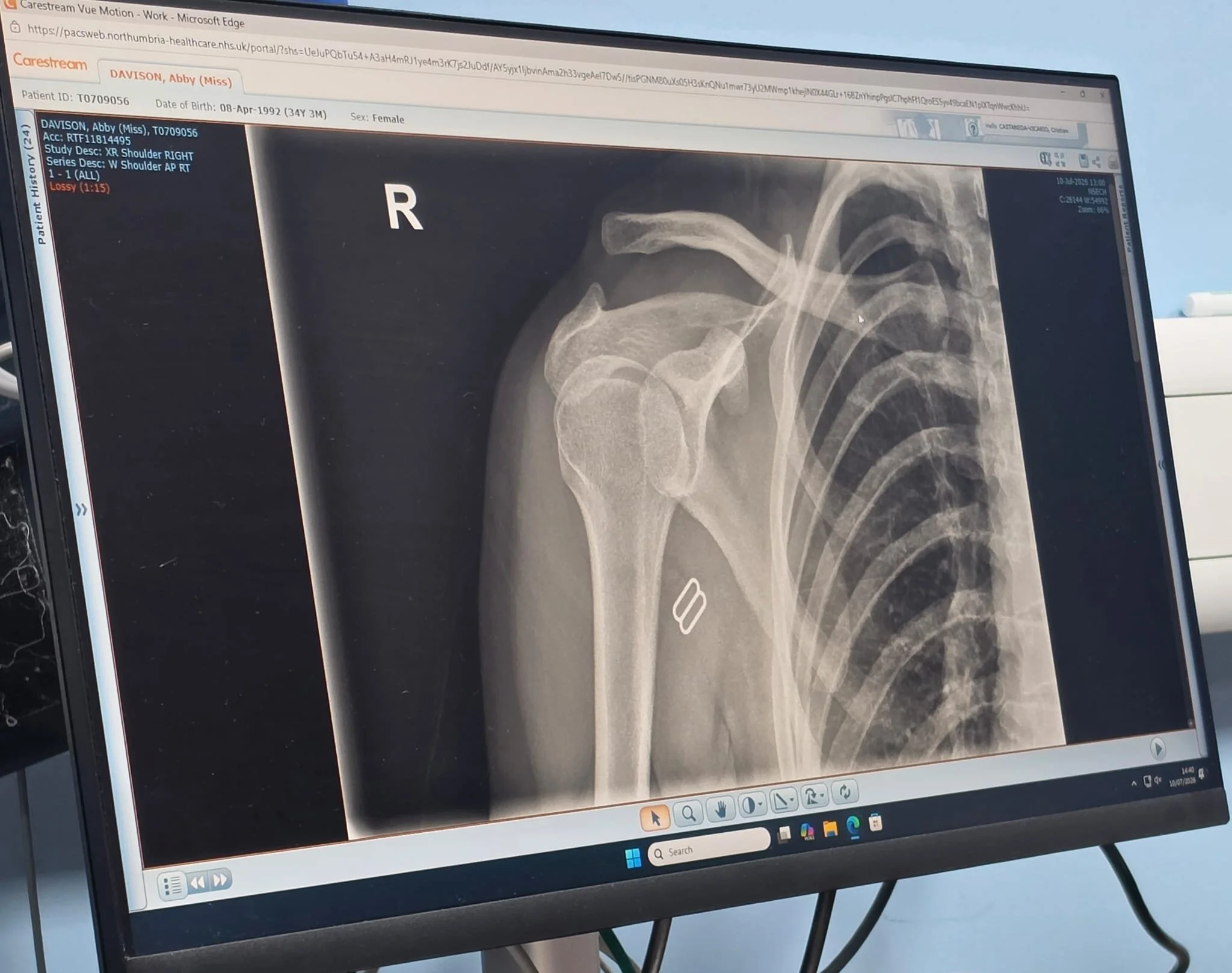
The x-ray showed a separated AC joint. That is the acromioclavicular joint, the small joint at the top of your shoulder where the collarbone meets the shoulder blade.
The first decision was to wait. Some AC joint injuries heal on their own, so we gave it two weeks to see whether mine would. It did not. So I was booked in for surgery.
The surgery
Before I was put under general anaesthetic, I had a nerve block put into my arm to help with the pain after the operation. It was done under ultrasound, and I will admit I found it fascinating. Ultrasound-guided nerve blocks are something I see done on horses, so watching one being done on me, on a screen, in real time, was a strange and brilliant thing to experience from the other side. I may have asked more questions than the average patient.
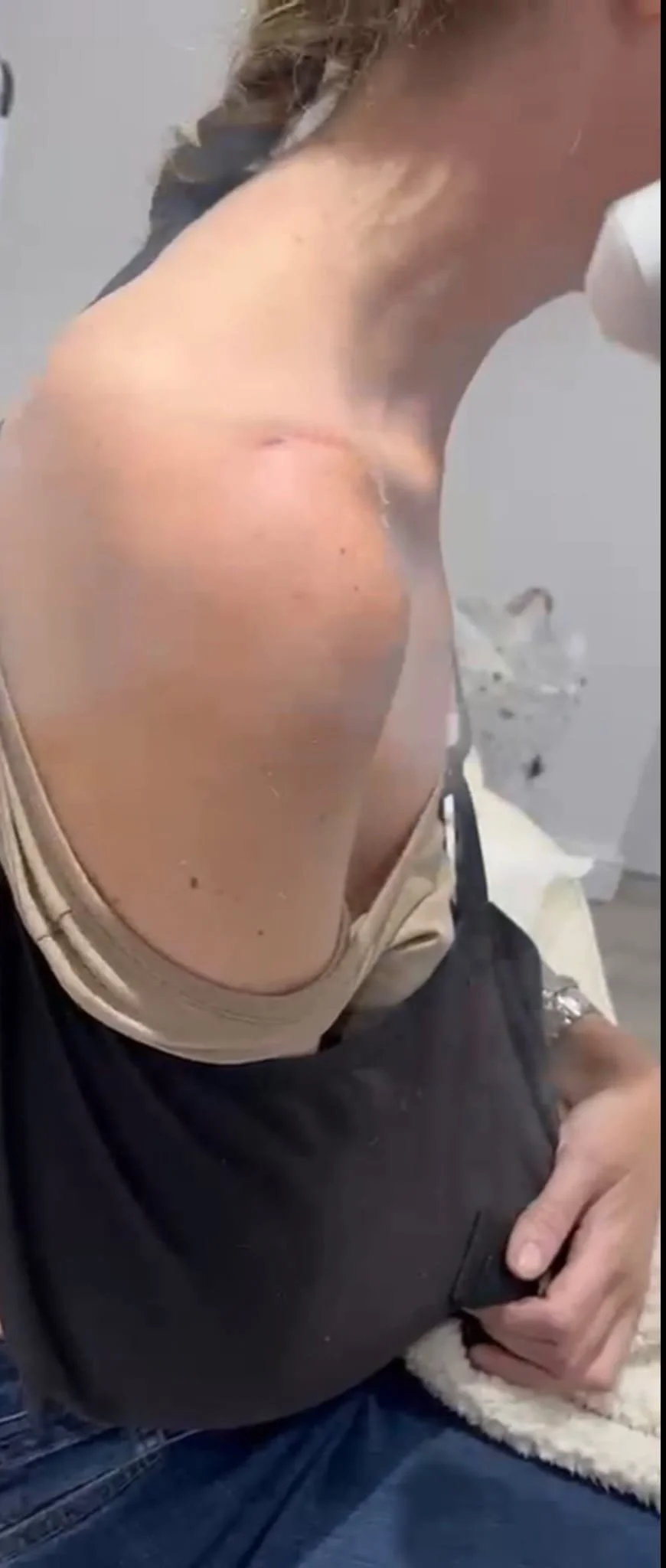
Then the surgery itself, which turned out to be bigger than planned. Once the surgeon was in, the damage went further than the x-ray had shown. The joint capsule was torn, and the deltoid, the big muscle over the top of the shoulder, was damaged as well.
One repair became three.
The AC joint was stabilised with a tightrope. That is a strong suture held between two small buttons, which pulls the collarbone back down into position and holds it there. Corkscrew anchors were fixed into the joint capsule to repair the tear. Then the deltoid was repaired and reattached.
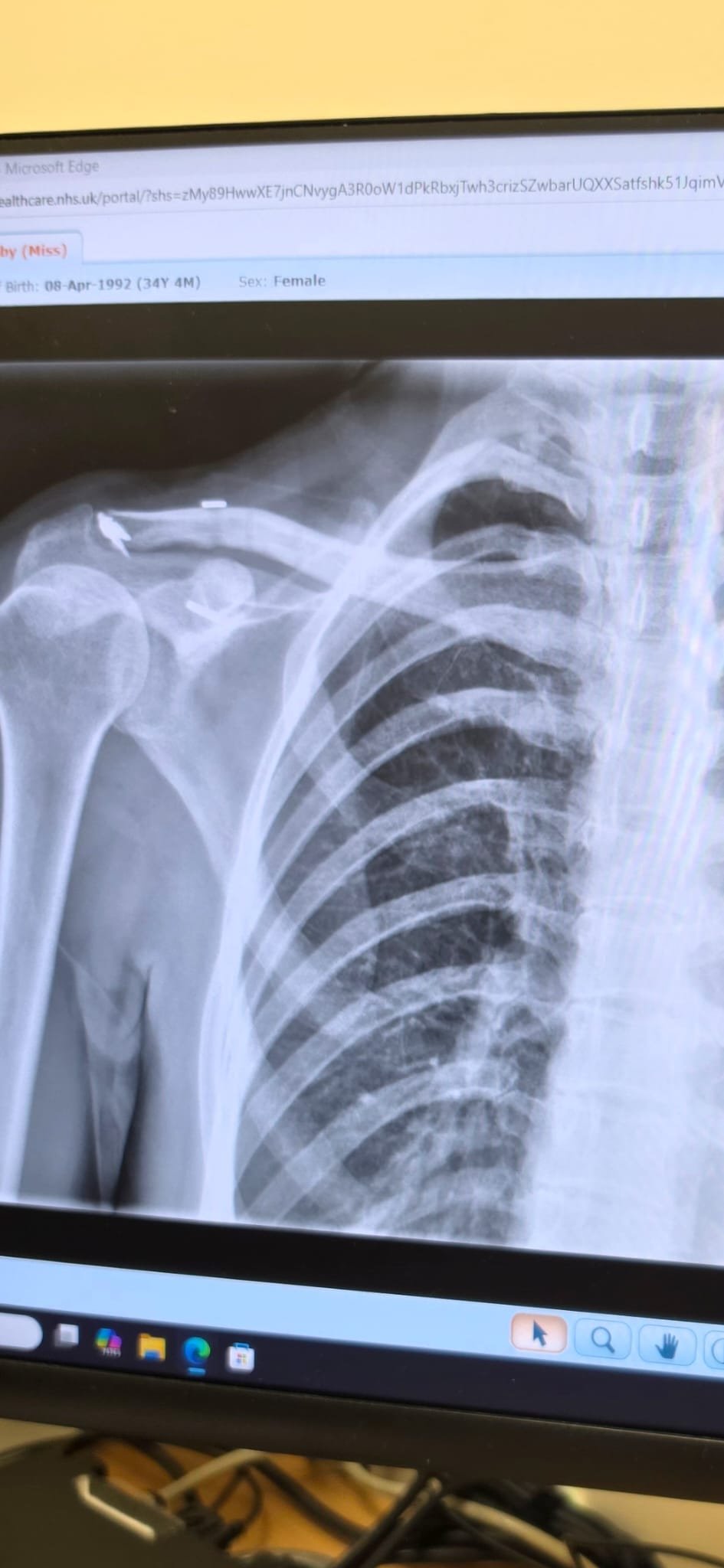
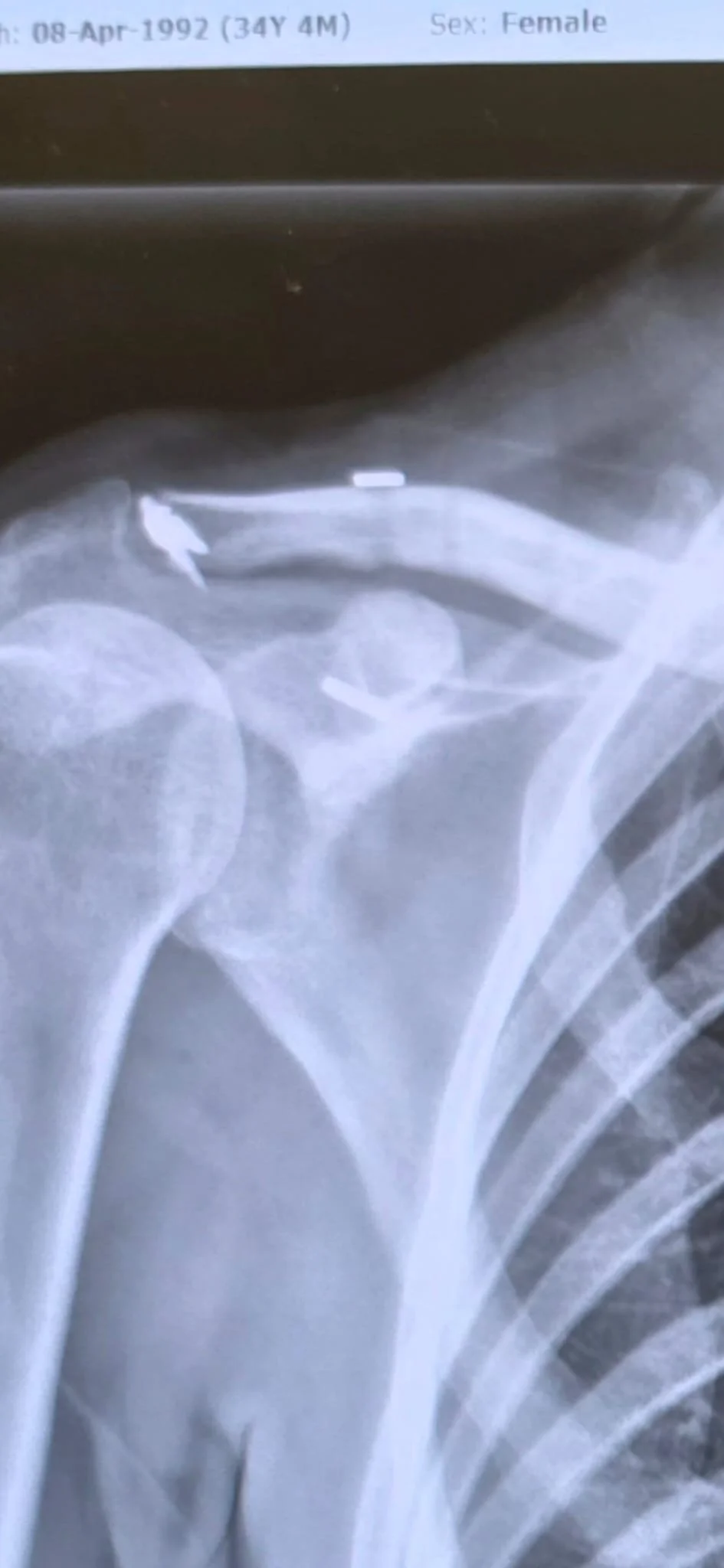
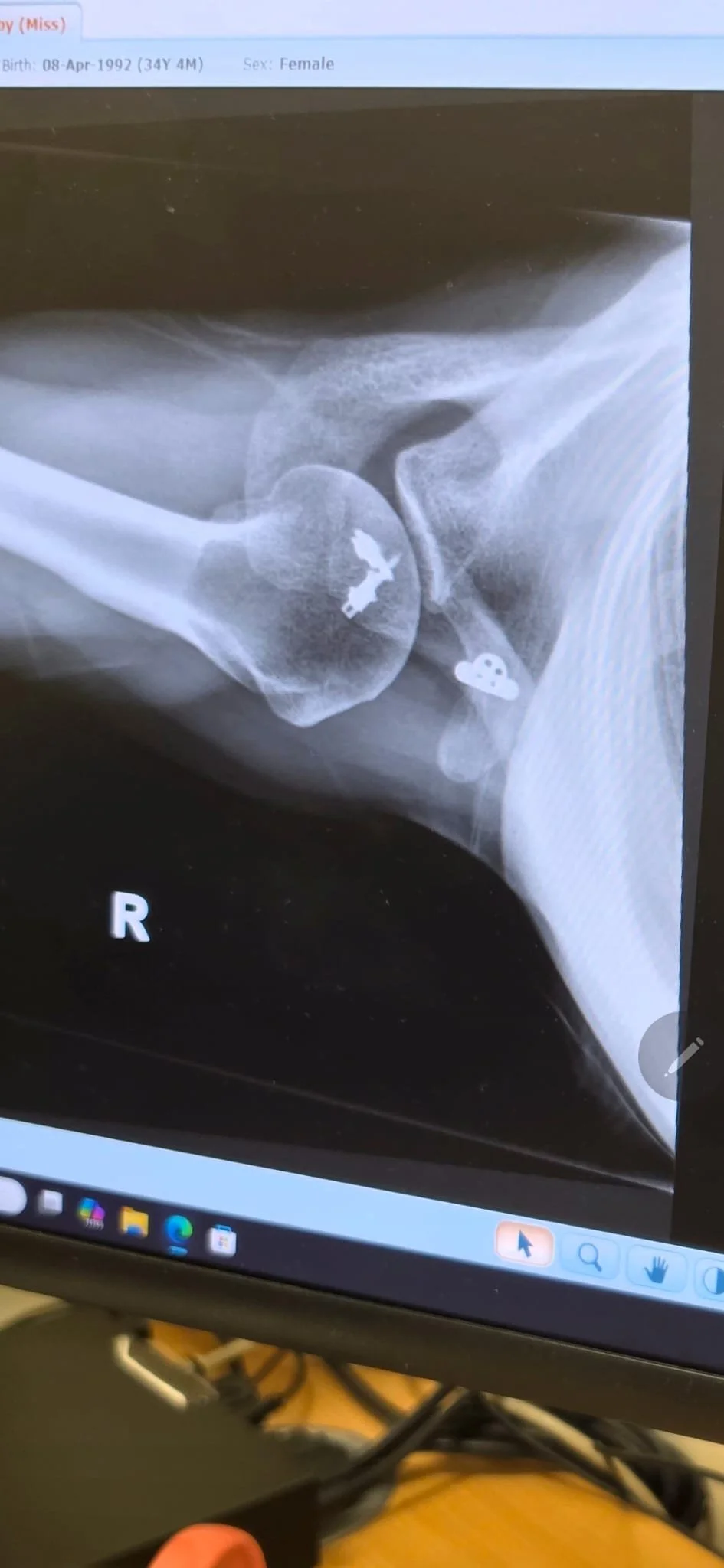
If you have ever sent a horse in for one procedure and had the vet ring to say they found two more, you will know the feeling. Imaging does not show everything. Sometimes the full picture only appears once somebody is inside.
A quick story from the recovery ward
I had literally just been wheeled back up onto the ward, still fuzzy from the anaesthetic, when my phone started ringing. It was Stallion AI. My mare was down at Twemlows; she was ready to be inseminated, and they needed me to order the semen. So there I was, fresh out of surgery, one arm strapped up, placing an order. To this day, I do not know how I picked the right stallion, but I did.
Halfway through, the doctor came to take my blood pressure. I looked up and said,
"Sorry, I'm on my phone; I'm just ordering semen."
Apparently, not one patient had ever said that to him before.
Horses do not stop because you are in hospital. That is part and parcel too.
Seven weeks in a sling
After the surgery, my arm went into a sling for seven weeks.
I am on the yard every day. Seven weeks of doing nothing is not something I am built for. I now have a lot more sympathy for every horse I have ever put on box rest. I will be honest about one thing. I got back to work far sooner than I should have. Seven Mile is my home and my business, and rehabilitation horses from before the accident were already in and still needed their programmes. Those horses didn't stop needing care just because I had a sling on. So I was back on the yard within days, in a fashion.
I say in a fashion because all I could do was oversee. I could not lead a horse, tack one up, muck out, or do any of the physical work. My team stepped up and stepped in, and they covered every bit of it. Every treadmill session, every stable, every horse that needed handling they delivered it, and I am more grateful for that than I can put into a blog post.
This is why it matters to have good people around you. Not just for the day everything goes wrong, but for the weeks afterwards when you are still not much use. If you have a team like that, look after them. If you are building one, this is what you are building it for.
And if you are not self-employed and you do not have a business to keep running, please do what I could not. Take the time off. Rest properly. The repairs need time to knit, just like a horse on box rest needs the full period whether it likes it or not, and there is no version of this where rushing it helps.
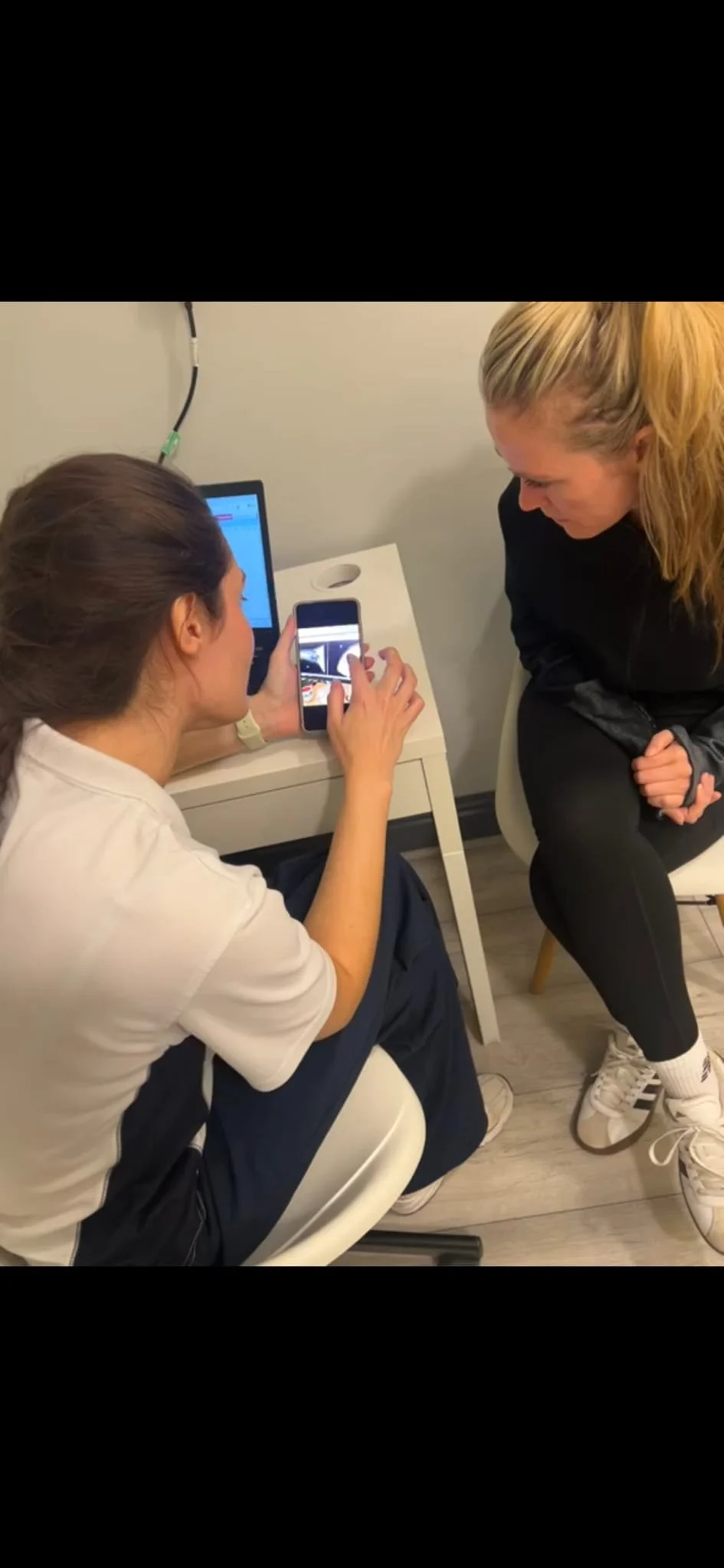
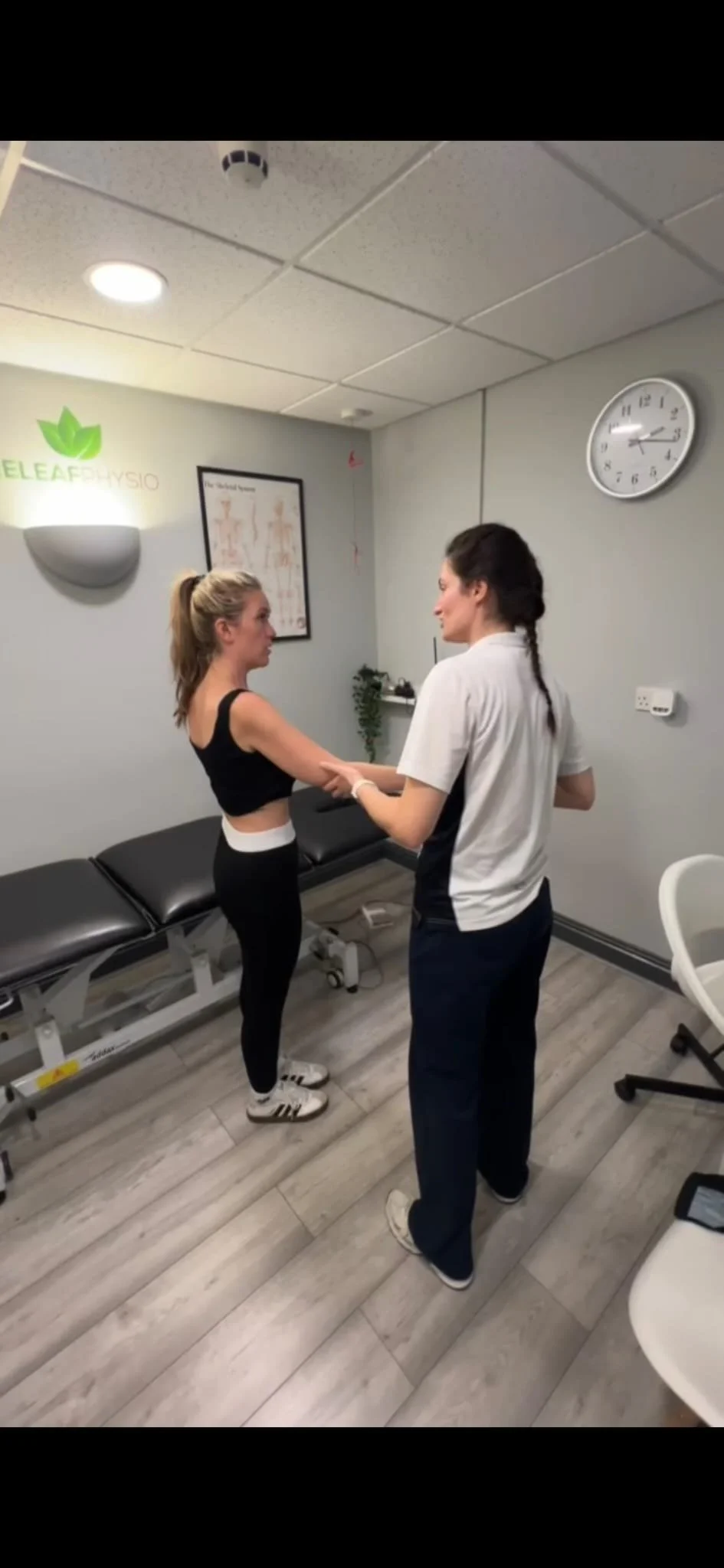
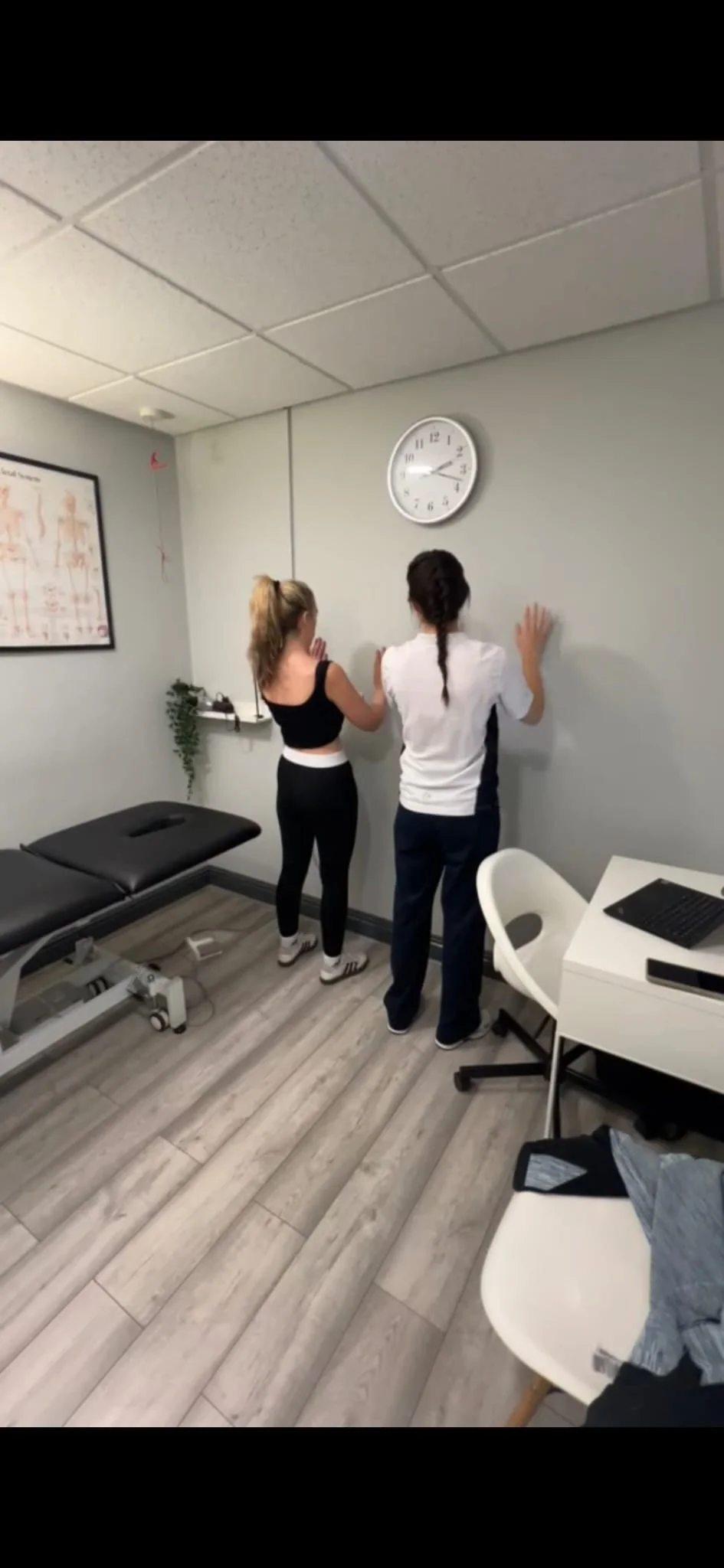
I came out of the sling last week and started physio. Physio is slow. It is repetitive, uncomfortable, and the only route back to full strength. So I am doing every session and every exercise I have been given, even the boring ones. Especially the boring ones.
What I have learnt
I asked the people around me what I had done well, because in the middle of an injury you cannot see it yourself. The answer was resilience. I stayed calm, and I stayed patient. Patience is not a word anyone would have used about me before this, so I am taking that as a win.
But the bigger lesson is the one I want you to take away.
I know how to rehab a horse. You do not cut the box rest short. You build the work up in stages. You don't skip the boring exercises, and you don't put a horse back into full work just because it looks sound from the outside. I have said all of this to owners for years.
And yet most of us, me included, are terrible at applying any of it to ourselves. We strap it up, get back on and hope for the best.
So this time I am doing it differently. Rehab yourself the way you would rehab your horse. Do not neglect yourself. Your horse needs you fit and strong just as much as you need them fit and strong. If you go back too early and break down again, nobody benefits, least of all the horse.Physio with Ellie at https://www.releafphysio.com/
My own horses
While the rehab horses carried on with the team, my own horses got a break. I am lucky that they could go out on holiday and take some time off. They have not complained. They will come back to work when I do, and the long-term plans can wait until I am fit enough to make them.
Back to work
I am building back up in stages now, exactly as I would with a horse coming back from injury. I will post another update in a few weeks so you can see how the physio is going.
If you have a horse coming back from injury or surgery and you are not sure how to build the work back up safely, get in touch. I now have first-hand experience on both sides.